
Picture this: a steel bar glowing cherry red in seconds, yet the heating element around it stays ice cold. Or your morning pot of water boiling while the stovetop beneath it barely warms up. These scenes share one powerful explanation: induction heating. This contactless technology uses electromagnetic fields to generate heat directly inside conductive materials, making it faster, cleaner, and more efficient than traditional heating methods.
In this guide, you will learn how an induction heater works from the ground up. We will cover the physics of electromagnetic induction, the components that make up a system, how frequency controls heating depth, and why this technology powers everything from industrial foundries to your kitchen cooktop. By the end, you will understand why induction heating has become a cornerstone of modern manufacturing and daily life.
The Physics Behind Electromagnetic Induction

How Magnetic Fields Create Heat in Metal
The entire process starts with a discovery by Michael Faraday: a changing magnetic field can induce an electric current in a nearby conductor. An induction heater exploits this principle using a high-frequency alternating current (AC) flowing through a copper coil called an inductor.
This rapidly reversing current creates a powerful magnetic field that expands and collapses thousands of times per second. When a conductive metal object enters this field, the field penetrates the material and induces swirling electric currents known as eddy currents. These internal currents encounter resistance as they flow through the metal’s atomic structure, and that resistance converts electrical energy into thermal energy through a process called Joule heating.
The result is heat generated from within the object itself, with no external flame, hot element, or physical contact required.
Why Iron Heats Faster Than Copper
For ferromagnetic materials like iron, nickel, and certain steels, there is a second heating mechanism at work: magnetic hysteresis. Below the Curie temperature (approximately 770°C for iron), these materials have high magnetic permeability, meaning their internal magnetic domains easily align with external fields.
As the AC field reverses direction rapidly, these domains constantly flip back and forth. This movement creates internal friction and generates additional heat. Once the metal exceeds the Curie point, it loses its magnetic properties and hysteresis heating stops, though eddy current heating continues. This dual effect is why iron and steel respond so well to induction heating.
Key Components of an Induction Heating System
The High-Frequency Power Supply
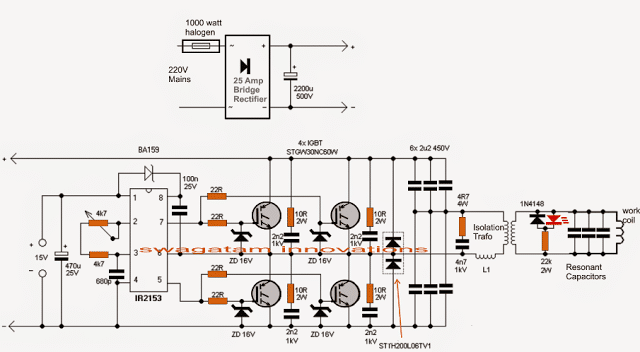
At the heart of every induction heater is a power supply that converts standard line voltage (50/60 Hz AC) into high-frequency AC ranging from 1 kHz to several hundred kHz. Modern systems use solid-state inverters built with components like IGBTs or MOSFETs to generate this high-frequency output efficiently.
The supply delivers low-voltage, very high-current electricity to the induction coil. Higher frequencies produce shallower, more focused heating, while lower frequencies allow deeper penetration into thicker materials.
Induction Coil Design and Materials
The induction coil shapes and directs the electromagnetic field. Most coils are made from hollow copper tubing, with water flowing through the tubing to carry away heat and keep the coil cool during operation.
The coil’s diameter, shape, and number of turns determine how the magnetic field distributes around the workpiece. Common configurations include:
- Helical coils for cylindrical parts
- Pancake coils for flat surfaces
- Internal coils for heating the inside of bores
Many systems pair the coil with a resonant capacitor tank to form an LC circuit, which improves efficiency by reducing reactive power losses.
The Workpiece and Coupling Distance
The workpiece is the object being heated, and it must be electrically conductive. Metals like steel, copper, aluminum, brass, and even graphite respond to induction, though effectiveness varies based on each material’s resistivity and permeability.
Coupling refers to the proximity and alignment between the coil and workpiece. Closer spacing increases energy transfer, but gaps that are too small can cause arcing or uneven heating. Best practice keeps the air gap under 3 to 5 mm and centers the part within the coil.
How Frequency Controls Heating Depth
The Penetration Depth Formula
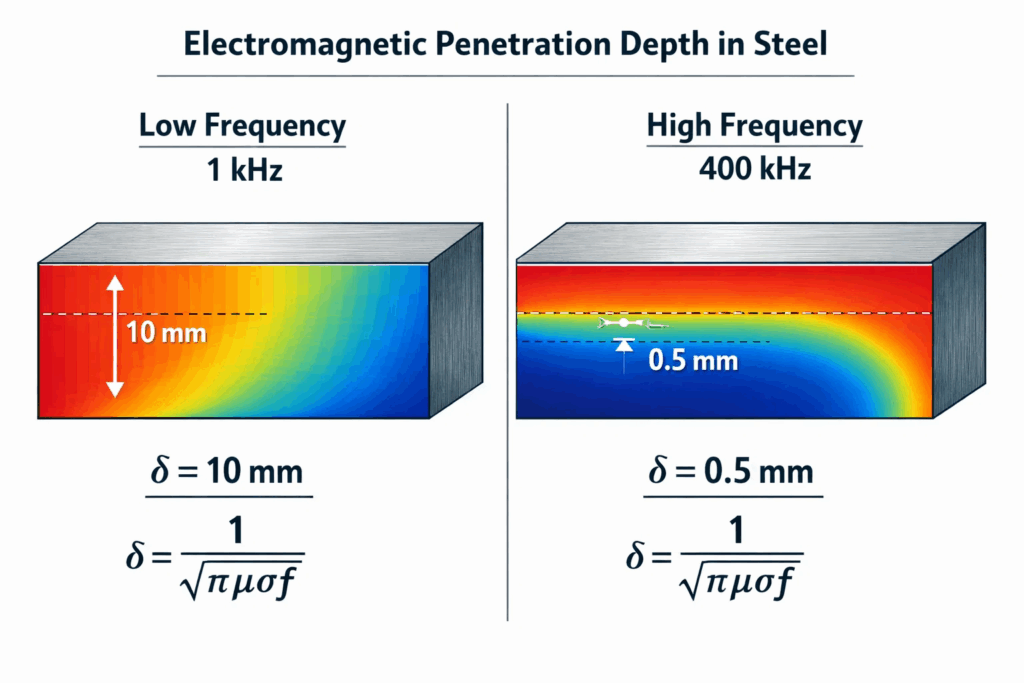
One of the most powerful features of induction heating is controllable heating depth. The frequency of the AC current directly determines how deeply eddy currents penetrate the material.
The standard penetration depth (δ) is defined as the depth at which about 86% of the heating power concentrates. It is calculated using this formula:
δ = 503 × √(ρ / μf)
Where:
– δ = penetration depth in meters
– ρ = electrical resistivity in ohm-meters
– μ = relative magnetic permeability
– f = frequency in Hz
Lower frequencies penetrate deeper into the material. Higher frequencies concentrate heat near the surface.
Matching Frequency to Application
| Frequency Range | Best Applications |
|---|---|
| 5–30 kHz | Thick materials (over 50 mm), deep heating for melting and forging |
| 100–400 kHz | Small parts, shallow surface hardening like gear teeth and small shafts |
| 480+ kHz | Microscopic components and precision surface treatments |
For example, hardening the surface of a steel shaft requires high frequency (100–400 kHz) to keep heat shallow and preserve the core’s toughness. Melting a ton of scrap steel uses low frequency (1–10 kHz) for deep, uniform heating throughout the entire mass.
The Critical Coupling Ratio (a/d = 4)
Heating efficiency peaks when the workpiece diameter (a) is approximately four times the reference depth (d). Engineers call this the critical frequency.
- Below this ratio: eddy currents from opposite sides of the workpiece interfere and cancel out, reducing efficiency.
- Above this ratio: increasing frequency yields diminishing returns in efficiency.
Manufacturers often design systems to hit this sweet spot, balancing heating performance against equipment cost.
Industrial Applications of Induction Heating
Melting Metals in Induction Furnaces
Induction furnaces provide a clean, efficient method for melting metal. A water-cooled copper coil surrounds a refractory-lined crucible containing the charge material. As the magnetic field induces eddy currents, the metal heats and eventually melts.
Once molten, the same magnetic field can stir the metal, ensuring even mixing of alloying elements. This is ideal for producing consistent steel or aluminum grades.
These furnaces range from small laboratory units holding 1 kg to massive industrial systems exceeding 100 tonnes. Because heating is non-contact, induction furnaces can operate in vacuum or inert gas environments, preventing oxidation in specialty alloys.
Surface Hardening of Steel Parts
Induction hardening selectively strengthens metal surfaces. A gear, shaft, or blade is rapidly heated to austenitizing temperature (800–900°C), then quenched with water or oil.
Only the surface layer hardens while the core remains tough and ductile. This improves wear resistance while maintaining impact strength. By adjusting frequency, power, and exposure time, engineers control case depth from 0.5 mm for small parts to over 5 mm for heavy components. The process is repeatable, fast, and easily automated, making it ideal for automotive and tool manufacturing.
Brazing and Soldering with Precision
Induction brazing joins metal parts using a filler metal melted by induced heat. Unlike torch brazing, it offers uniform heating and minimal oxidation, especially in controlled atmospheres.
Common applications include:
– Joining carbide tips to drill bits
– Attaching connectors in electrical components
– Assembling HVAC tubing
The localized heat prevents warping and ensures strong, clean joints.
Welding Metal Tubes Seamlessly
In tube welding, induction heats the edges of a rolled metal strip just before they are pressed together. High-frequency currents flow along the open seam, raising the temperature to welding range (over 1,200°C).
No external electrodes or flames are needed. The result is strong, consistent welds at high production speeds. Even plastic tubes can be sealed if embedded with ferromagnetic particles that heat via hysteresis.
Induction Cooking for Fast, Safe Meals

Induction cooktops use a coiled copper wire beneath a ceramic surface. When a ferromagnetic pot is placed on top, the magnetic field induces eddy currents in the base, heating it directly.
Key benefits include:
– 90% energy efficiency compared to 40–55% for gas or electric
– Cooktop stays cool since only the pan heats
– Instant control: heat stops immediately when power cuts
– Safer operation with no open flame or red-hot element
Non-ferrous pans like aluminum or copper will not work unless they have a magnetic layer bonded to the base.
Sealing Caps in Pharmaceutical Packaging
In food and drug packaging, induction sealing fuses aluminum foil to container lids. A conveyor belt passes bottles under a high-frequency coil, which heats the foil liner and melts it onto the rim.
This creates an airtight, tamper-evident seal critical for product safety and shelf life. The process is fast, non-contact, and fully automated.
Heating Bearings for Installation
Mechanics use induction to expand bearings before mounting. Heating causes thermal expansion, allowing the bearing to slide easily onto a shaft. As it cools, it contracts into a tight, secure fit.
Utility-frequency (50/60 Hz) systems with laminated cores are often used for this task. The process avoids hammering or excessive force, reducing the risk of damage.
Plastic Injection Molding Efficiency
Induction heats the barrel of plastic extruders and injection machines directly rather than relying on external band heaters. This cuts warm-up time by up to 80% and reduces energy consumption.
Frequencies between 5–30 kHz are typical, depending on barrel thickness. The coil operates outside thermal insulation, staying cool and durable. Some systems also heat molds, improving temperature uniformity and part quality.
Producing Biochar Through Pyrolysis
In biomass pyrolysis, induction heats reactor walls directly, transferring heat to organic material inside. This enables precise temperature control and efficient charring without open flames.
The method is used to produce biochar, a carbon-rich soil enhancer, ensuring clean and consistent results with good mixing in shaker reactors.
Breaking Rusted Bolts with Localized Heat
Mechanics use portable induction heaters to loosen seized or rusted bolts. Localized heating expands the nut or surrounding metal, breaking the bond caused by corrosion.
The process is faster and safer than using an open-flame torch, with less risk of fire or warping nearby components.
Factors That Affect Induction Heating Efficiency
Material Properties Make a Difference
Not all metals heat equally. Key factors include:
- Electrical resistivity (ρ): Higher resistivity means more resistance to current flow and more heat generation. Steel heats better than copper for this reason.
- Magnetic permeability (μ): Ferromagnetic materials like iron and nickel heat faster due to hysteresis effects.
- Temperature effects: Permeability drops above the Curie point while resistivity increases with temperature, both changing heating dynamics.
Aluminum and copper, while highly conductive, require higher frequencies or specialized coils due to their low resistivity and non-magnetic nature.
Distance and Alignment Impact Performance
Energy transfer drops sharply with distance. Even a small air gap between coil and workpiece reduces efficiency significantly.
Best practices include:
– Keep the gap under 3–5 mm
– Center the part within the coil
– Use flux concentrators to focus the magnetic field
Fixtures should minimize heat loss through conduction while allowing adequate cooling when needed.
Heat Loss Mechanisms
Despite high overall efficiency, some energy escapes through:
– Thermal conduction to surrounding fixtures
– Natural convection to ambient air
– Radiation, especially above 500°C
Insulation and shielding help retain heat, particularly in continuous industrial processes.
Advantages Over Traditional Heating Methods
Speed, Control, and Cleanliness
Compared to gas furnaces or resistance ovens, induction heating offers:
- Faster heating: seconds instead of minutes
- Precise control: adjust power, frequency, and time independently
- Localized heating: only the target area gets hot
- Energy efficiency: up to 90% in optimal setups
- No emissions: ideal for cleanrooms and vacuum environments
The process is also highly automatable, integrating easily into modern production lines.
Limitations and Challenges
High Initial Investment and Custom Coils
Induction systems require significant upfront investment, especially for high-power or high-frequency units. Each application often needs a custom-designed coil, increasing setup cost and lead time. Complex geometries may require multiple coils or robotic positioning systems.
Conductivity Requirement
Only conductive materials can be heated. Non-metals like glass, ceramics, and most plastics will not respond unless embedded with metal or magnetic particles. Even among metals, copper and aluminum are harder to heat than steel due to their low electrical resistance.
Frequency and Penetration Trade-Offs
Choosing the right frequency is critical. Too high means only the surface heats. Too low means inefficient heating for small parts. Engineers must carefully balance depth, speed, and equipment cost for each application.
Frequently Asked Questions About Induction Heating
What is the main principle behind induction heating?
Induction heating works by passing a high-frequency alternating current through a copper coil, which creates a rapidly changing magnetic field. When a conductive metal object enters this field, eddy currents are induced inside the object. These currents generate heat through electrical resistance, a process called Joule heating. The heat is produced within the object itself rather than from an external source.
Why do some metals heat faster than others in induction systems?
Metals with higher electrical resistivity, like steel, generate more heat because they resist current flow more strongly. Ferromagnetic metals like iron also benefit from magnetic hysteresis heating below the Curie temperature. Copper and aluminum, with low resistivity and no magnetic properties, heat less efficiently and require higher frequencies or specialized coils.
What frequency is used for induction heating?
Frequencies range from about 1 kHz to several hundred kHz depending on the application. Low frequencies (5–30 kHz) suit thick materials and deep heating. High frequencies (100–400 kHz) are used for small parts and shallow surface hardening. Microscopic work may use frequencies above 480 kHz.
Can induction heating work on non-metallic materials?
Standard induction heating only works on conductive materials. However, non-metals like certain plastics can be heated if they are doped with ferromagnetic ceramics or metallic particles. These embedded particles heat through hysteresis or eddy currents, allowing indirect heating of the surrounding material.
Is induction cooking more efficient than gas or electric stoves?
Yes. Induction cooktops convert about 90% of their energy into heat in the food, compared to roughly 40–55% for gas and traditional electric stoves. Since the cooktop surface itself does not get hot, less energy is wasted heating the surrounding air. Heat also stops almost instantly when the pan is removed or the power is turned off.
What are the main industrial uses of induction heating?
Induction heating is widely used for melting metals in foundries, surface hardening of steel parts, brazing and soldering, tube welding, induction cooking, cap sealing in pharmaceutical packaging, bearing installation, plastic injection molding, biochar production, and removing rusted bolts. Its speed, precision, and cleanliness make it valuable across many industries.
Key Takeaways for Understanding Induction Heating
Induction heating is a transformative technology that generates heat directly inside conductive materials using electromagnetic fields. The process relies on eddy currents and, for ferromagnetic materials, magnetic hysteresis to convert electrical energy into thermal energy with remarkable speed and precision.
The three most important factors that determine heating performance are frequency, which controls penetration depth; material properties, including resistivity and permeability; and coil design, which shapes the magnetic field. Understanding how these elements interact allows engineers and users to optimize heating for virtually any application.
Whether you are troubleshooting an induction cooktop, specifying equipment for a manufacturing process, or simply curious about the technology behind your morning coffee, knowing how an induction heater works unlocks better performance, safety, and efficiency. As power electronics continue to become more affordable, expect induction heating to expand into even more industries, from aerospace to sustainable energy production.