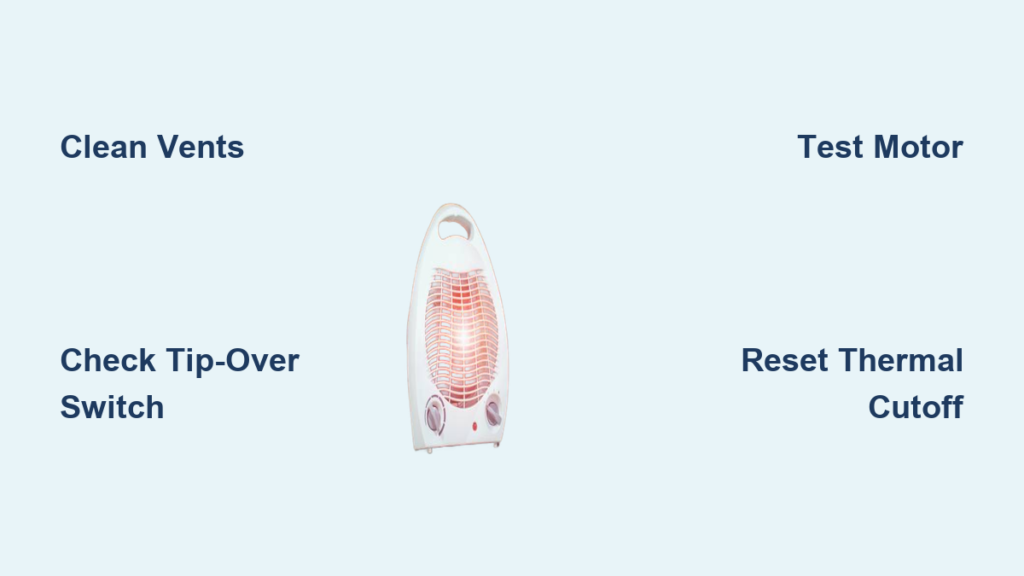
You flip on your space heater, hear the fan kick in, but only cold air comes out. Frustrating and confusing. If your space heater not blowing hot air, you are not alone. This is one of the most common heating season complaints, affecting thousands of households every winter.
The good news: in over 70% of cases, the issue is not a dead heater. Most problems stem from blocked airflow, tripped safety switches, or failed heating elements. With a few simple checks, you can often restore heat in under 30 minutes.
Blocked Airflow: The #1 Cause
Dust, pet hair, and lint build up fast inside a space heater. When grilles or internal pathways get clogged, airflow drops. The fan runs, but air cannot pass over the heating element, so no hot air comes out.
Even worse: restricted airflow causes overheating. That triggers safety systems that shut off the heat while keeping the fan on to cool things down.
How to Clear Airflow Blockages
• Unplug the unit and let it cool for 30 minutes.
• Inspect front and rear grilles for visible debris.
• Use compressed air or a cool-setting hair dryer to blow dust out from both sides.
• Remove screws to open the casing and access internal components.
• Spray air into the fan blades, heating chamber, and ducts.
• Tip the heater gently to dislodge trapped dust.
• Reassemble carefully without pinching any wires.
Pro Tip: Hold a tissue near the intake. If suction is weak, blockage remains. Repeat cleaning until airflow feels strong.
Reset Tripped Overheat Protection
All modern space heaters have thermal cutoff switches. If internal temperatures rise too high due to dust, poor placement, or long run times, the switch cuts power to the heating element.
But here is the catch: the fan often keeps running to cool the unit. That is why you get airflow with no heat.
How to Reset Safety Locks
• Unplug the heater.
• Let it sit off for 10 minutes to reset thermal sensors.
• Plug it back in on a clear, flat surface.
• Set thermostat to maximum and wait 60 seconds.
If heat returns, the problem was overheating. Clean the unit and avoid running it more than 2 to 4 hours continuously.
Warning: Some models have non-resettable thermal fuses. If tripped, they must be replaced or the unit retired.
Failed Heating Element: Silent Killer
If airflow is clear and safety switches reset but still no heat, the heating element is likely dead.
Common types include ceramic heaters (most modern models), PTC elements (self-regulating, less likely to fail), and metal coils (older models with visible glow when working).
Test for a Bad Heating Element

• Unplug and disassemble the heater.
• Locate the heating element, usually behind the fan.
• Use a multimeter set to ohms.
• Touch probes to both terminals of the element.
Result: Continuity (low resistance) means the element is good. Infinite resistance (OL) means the element is open and needs replacement.
Reality Check: Most portable heaters do not sell replacement elements. If it has failed, replacement is often cheaper than repair.
Check the Tip-Over Switch
The tip-over safety switch disables heating if the unit tilts more than 15 to 30 degrees. It is a critical fire prevention feature, but it can malfunction.
Why It Fails
• Placed on carpet or uneven floor
• Debris (dust, coins) jamming the mechanism
• Internal switch wear over time
Quick Diagnostic Test
• Place the heater on a hard, level surface.
• Clean around the base.
• Temporary test: Tape the switch in upright position (only for testing).
• Turn on. If heat returns, the switch is faulty.
Never bypass this permanently. It is a fire safety essential. Replace the unit if the switch is broken.
Power Supply and Outlet Problems
No heat? First, confirm the heater is getting power.
Rule Out Electrical Issues
• Test the outlet with another high-watt device like a hair dryer.
• Check your breaker panel for tripped switches.
• Inspect the heater power cord for fraying, kinks, or melted spots.
Critical: Space heaters draw 750 to 1500 watts. That is a heavy load.
Extension Cord Danger Zone
Using a flimsy extension cord is a common cause of no heat issues.
Safe Use Only If: Cord is 14-gauge or thicker, 3-prong and grounded, rated for 15+ amps (look for orange jacket), and plugged directly into wall with no power strips.
Best Practice: Plug the heater directly into the wall outlet. Avoid extensions entirely.
Faulty Thermostat or Control Board
If your heater runs but never heats up or cycles erratically, the thermostat may be stuck.
How to Test the Thermostat
• Turn the dial from lowest to highest setting 10 times. This can free stuck internal contacts.
• Listen for a click when heat should engage.
• If no click and fan runs without heat, the thermostat may be dead.
Advanced Check with Multimeter
• Test for continuity across thermostat terminals.
• No signal means replace the thermostat or the unit.
Note: On digital models, a failed control board may require full replacement.
Inspect for Internal Wiring Faults
Over time, wires inside the heater can loosen, corrode, or melt from heat exposure.
What to Look For
After unplugging and opening the unit, check for loose connections at the heating element or fan motor, discolored or brittle insulation, burn marks on terminals, and rodent damage in storage.
Repair or Replace
• Reconnect or solder loose wires if you are skilled.
• Replace damaged wires with same-gauge type.
• If you see melted plastic or burnt components, do not repair. Replace the unit.
Safety First: Only attempt internal repairs if you understand basic electrical safety. Otherwise, retire the heater.
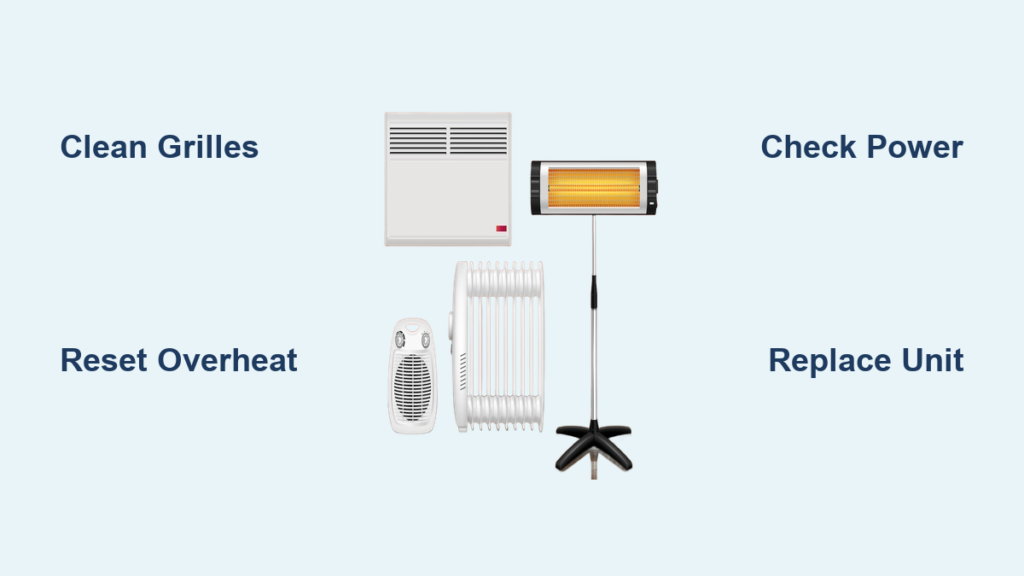
Step-by-Step: Fix It in 10 Minutes
Follow this fast-troubleshooting checklist:
- Safety First: Unplug the heater and let it cool completely.
- Reset the System: Wait 10 minutes to reset thermal cutoffs.
- Check Power: Test outlet with another device and confirm breaker is on.
- Clean Grilles: Use compressed air on intake and exhaust.
- Verify Placement: Is it on a flat, hard surface? Is it 3+ feet from furniture, curtains, bedding?
- Test Heat: Plug in, set to high, wait 60 seconds.
If heat works, the problem was overheating or blockage. If no heat, move to deep diagnostics (element, wiring, thermostat).
Prevent Future Failures
Most space heater problems are preventable. Follow these habits:
Clean Every 1 to 2 Months
• Vacuum grilles.
• Blow out internal dust once per season.
Monthly Safety Check
• Inspect cord and plug.
• Test tip-over and overheat functions.
Proper Placement
• Hard floor only. Never on rugs, beds, or sofas.
• 3 feet clear on all sides.
• Away from foot traffic.
Smart Usage
• Run max 2 to 4 hours at a time.
• Never leave unattended or while sleeping.
• Plug directly into wall.
Repair vs. Replace: When to Let Go
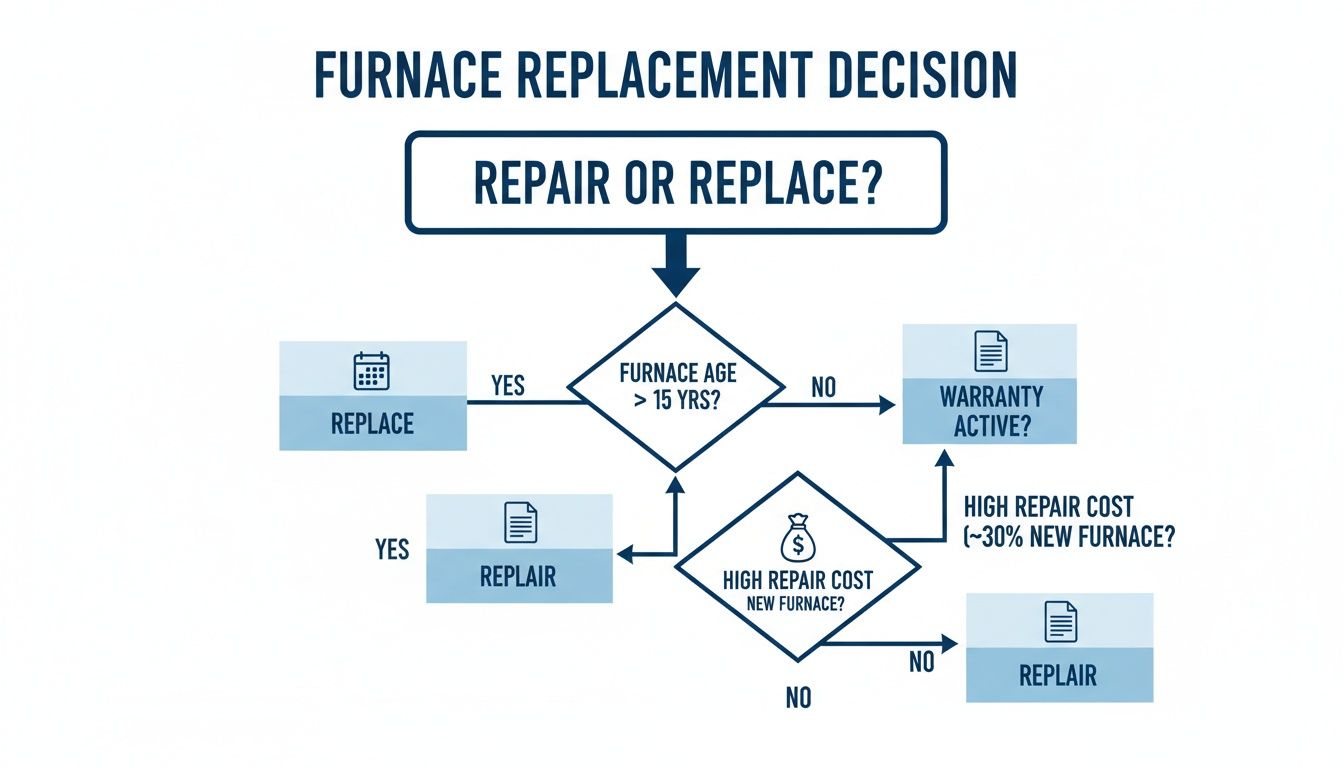
Most portable heaters are not designed to be repaired. Here is when to walk away:
| Condition | Replace Now |
|---|---|
| Over 5 years old | Yes |
| Burnt smell or melted parts | Yes |
| Cracked housing or frayed cord | Yes |
| Repair cost exceeds 50% of new unit | Yes |
| No UL/ETL safety certification | Yes |
Rule of Thumb: If a new UL-listed ceramic heater costs under $30, just replace it.
Safety First: Avoid Fire Risks
Space heaters cause 30 to 40% of home heating fires. Most are preventable.
5 Non-Negotiable Rules
• 3-Foot Rule: Keep away from anything flammable.
• Supervise Always: Never leave on while sleeping or unattended.
• Plug Direct: No power strips or daisy-chained cords.
• Certified Only: Use UL, ETL, or CSA-listed units.
• No Bathrooms: Never use near water or in damp areas.
Final Fixes and Long-Term Solutions
Immediate Action Plan
• Unplug and cool the heater.
• Clean grilles and internals.
• Reset for 10 minutes.
• Test on a hard, flat surface.
• Check power and cord.
• If no heat, replace, especially if old or damaged.
Long-Term Strategy
• Clean monthly during use.
• Replace every 5 years.
• Invest in central heating if relying on multiple heaters.
• Choose safety-certified models every time.
A space heater not blowing hot air is rarely a mystery. It is usually a cry for maintenance, better placement, or retirement. Fix the root cause today and stay warm safely all winter.
Frequently Asked Questions About Space Heater Not Blowing Hot Air
Why does my space heater run but not produce heat?
This usually happens due to blocked airflow, a tripped thermal cutoff, or a failed heating element. The fan may run while the heating element is disabled by safety systems. Clean the unit and reset it to troubleshoot.
How do I reset my space heater after it stops blowing hot air?
Unplug the heater and let it sit for 10 minutes. This allows internal thermal sensors to cool and reset. Plug it back in on a hard, flat surface and test again.
Can a dirty filter cause a space heater to blow cold air?
Yes. Dust and debris blocking the intake or exhaust grilles restrict airflow. When air cannot pass over the heating element, the unit overheats and safety systems shut off the heat while keeping the fan running.
Is it worth repairing a space heater that stopped working?
Most portable heaters are not cost-effective to repair. If the unit is over 5 years old, has burnt components, or lacks modern safety features, replacement is usually the better choice.
What extension cord should I use for a space heater?
Use a heavy-duty 14-gauge or thicker extension cord that is 3-prong and grounded, rated for 15+ amps. Plug it directly into the wall and avoid power strips entirely.
How often should I clean my space heater?
Clean intake and exhaust grilles every 1 to 2 months during heating season. Perform deep internal cleaning once per season to prevent dust buildup and maintain airflow.
Key Takeaways for Fixing Your Space Heater Not Blowing Hot Air
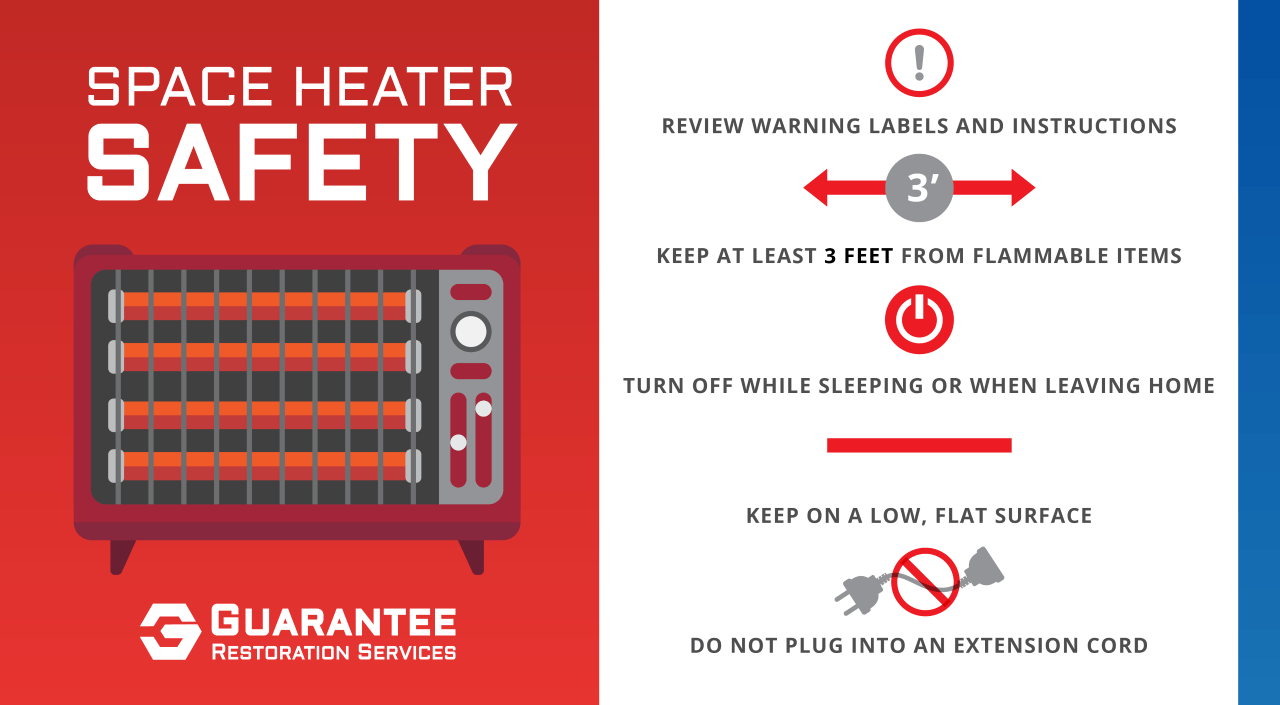
When your space heater not blowing hot air becomes a problem, start with the simplest fixes first. Blocked airflow from dust and debris is the number one cause, and cleaning the grilles often resolves the issue immediately. Resetting thermal cutoffs by unplugging for 10 minutes frequently restores heat if the unit overheated. Always check power supply and placement before moving to deeper diagnostics.
If cleaning and resetting do not work, the heating element, thermostat, or tip-over switch may be faulty. Most portable heaters are not worth repairing, especially if they are over 5 years old. A new UL-certified ceramic heater under $30 is a safer, more reliable solution than attempting complex repairs. Remember to clean monthly, place on hard surfaces only, and never leave the heater unattended.