A space heater tripping the breaker is more than an annoyance. It is a warning sign that your electrical system cannot safely handle the load. Most portable heaters draw 1,500 watts, which already exceeds the safe continuous capacity of a standard 15-amp circuit. When you add lamps, TVs, or chargers, even briefly, the total load pushes the circuit over its limit, forcing the breaker to trip and cut power. This is not a flaw. It is the system working as designed to prevent overheating, damaged wiring, and fire. The key to stopping the tripping lies in understanding your home or RV electrical layout, managing power use, and applying targeted fixes.
This guide delivers actionable steps to diagnose and resolve the problem safely and permanently. Whether the issue stems from overload, faulty wiring, or incompatible equipment, you will learn exactly what to check, what to fix, and when to call a professional.
Identify the Overloaded Circuit

Unplug Everything on the Circuit
Start by eliminating all electrical loads on the tripped circuit. Turn the breaker fully off, then back on to reset it. If it trips immediately with no devices plugged in, skip to checking for wiring faults or a bad breaker. If it holds, plug in only the space heater. Set it to low heat first. If the breaker holds, gradually increase to high. If it trips even alone, the heater may be defective. If it holds with the heater but trips when other devices are added, you have confirmed circuit overload.
Map Your Home Electrical Circuits
You cannot manage what you do not know. Most outlets in a room share a single circuit, and users often unknowingly overload them. To map your circuits, follow these steps.
- Turn off one breaker at a time.
- Test outlets, lights, and appliances with a lamp or outlet tester.
- Mark each powered device on a floor plan.
- Repeat for every breaker.
This reveals which devices compete for power. For example, a bedroom heater might share a circuit with hallway lights and a closet fan. These small loads add up quickly. Once mapped, you can strategically avoid using high-draw appliances together.
Pro Tip: Label breakers in your panel after mapping. Use colored tape or a printed chart so anyone in the home knows which switch controls what.
Prevent Circuit Overload
Plug Heater Directly into Wall Outlet
Never use an extension cord or power strip with a space heater unless it is rated for 1,500W continuous use. Most are not. Even heavy-duty cords can overheat, increase resistance, and cause voltage drop. This forces the heater to draw more current and trip the breaker. The safest method is plugging the heater directly into a wall outlet.
If you must use an extension cord, follow these requirements.
• Use 12-gauge or 14-gauge wire
• Keep it under 6 feet long
• Ensure it is rated for 15A or higher
• Leave it fully uncoiled and uncovered
But better yet, just do not use one.
Run Only One High-Wattage Device at a Time
A 1,500W heater leaves little room on a 15A circuit. Avoid running other high-draw appliances simultaneously, such as:
• Microwave (1,000 to 1,500W)
• Hair dryer (1,200 to 1,800W)
• Vacuum (600 to 1,500W)
• Coffee maker (800 to 1,200W)
Even a 60W LED lamp or 100W laptop adds stress over time. Limit other devices while the heater runs. In RVs, this is especially critical. Many outlets are on a single GFCI-protected circuit, and combining a heater with a microwave or coffee maker will almost certainly trip it.
User Hack: Use your space heater on a bedroom circuit at night, but switch to the kitchen circuit during the day when other appliances are not in use.
Use Lower Heat Settings
Most space heaters have low (750W to 900W) and high (1,500W) settings. Dropping to low reduces amperage from 12.5A to 6 to 7.5A. This frees up headroom on the circuit. In well-insulated rooms or for short-term heating, low setting may be sufficient. Pair this with closing doors to trap heat, using draft stoppers under doors, and running ceiling fans in reverse to push warm air down.
You will reduce tripping risk and save energy.
Upgrade Electrical Capacity

Install a Dedicated Circuit
The most effective long-term fix is installing a dedicated 15A or 20A circuit for your space heater. This eliminates competition from other devices. A dedicated circuit includes new wiring (14 AWG for 15A, 12 AWG for 20A), a single outlet (NEMA 5-15R or 5-20R), and a breaker used only for the heater.
While this requires a licensed electrician, it is ideal for rooms where you use a heater daily. This includes a basement office or guest bedroom.
Expert Insight: “This gives your heater its own lane on the highway,” says Brook Field Service. No more traffic jams.
Upgrade to a 20-Amp Circuit
If your heater keeps tripping a 15A breaker, upgrading to a 20A circuit increases safe continuous load from 1,440W to 1,920W. This provides enough headroom for a 1,500W heater plus a lamp or TV. Requirements include 12-gauge wiring, a 20A-rated outlet (NEMA 5-20R, with one horizontal slot), and a 20A breaker.
Warning: Never install a 20A breaker on 14-gauge wire. It can overheat and cause a fire. Upgrades must match wire gauge and outlet ratings.
Check First: Use a plug-in outlet tester to verify if your outlet is already 20A-compatible.
Diagnose Hidden Electrical Faults
Test the Heater on a Different Circuit
Plug the heater into a known-good circuit. This could be a garage, kitchen, or basement outlet. If it runs without tripping, the problem is your original circuit, not the heater. If it trips on multiple circuits, the heater itself is likely faulty.
Signs of a defective heater include trips breaker immediately, burning smell or buzzing noise, discoloration on plug or outlet, and inconsistent heating. If any of these occur, unplug and replace the heater. Do not continue using it.
Check for GFCI or AFCI Tripping
In kitchens, bathrooms, and RVs, outlets are often GFCI-protected. These detect ground faults (as little as 5mA leakage) and trip to prevent shock. Some older or low-quality heaters emit electrical noise or minor leakage that triggers nuisance GFCI trips.
To test, press the TEST button on GFCI outlets. It should trip. Press RESET. It should restore power. If it will not reset, there is a ground fault or wiring issue.
Also check for AFCI breakers, which detect dangerous arcing and may trip due to worn heater cords.
Clarification: In RVs, a GFI breaker is often just a standard breaker feeding GFCI outlets, not a combined GFCI/breaker unit (which has a TEST button).
Inspect for Loose or Damaged Wiring
Loose connections at outlets, junction boxes, or the breaker panel increase resistance, generate heat, and can trip breakers even under normal load. Check for warm or hot outlets, discoloration or scorch marks, flickering lights when heater starts, and buzzing from outlets or panel.
In older homes or factory-installed RVs, 14-gauge Romex may be used on circuits that now carry heavy loads. Continuous 12.5A draw can overheat these wires. One RV expert warns that sooner or later, one of your factory wall outlets will fail.
Critical: If you feel heat at an outlet or see damage, stop using it and call an electrician.
Replace or Upgrade Faulty Components
Replace Old or Weak Circuit Breakers
Breakers degrade over time. A unit that trips below its rated load or will not stay reset may have a weakened internal mechanism. This is common in homes or RVs over 15 to 20 years old.
To test, turn off the breaker, unplug all devices, and turn it back on. If it trips immediately with no load, the breaker is likely failing.
Warning: A bad breaker may also fail to trip when it should, creating a fire hazard. Replace suspect breakers with the same amperage and type. Never upsized.
Upgrade RV or Low-Grade Outlets
Factory RV outlets are often not built for continuous 12.5A draw. They may use thin plastic boxes and undersized terminals that overheat. Upgrade to residential-grade outlets, old-work electrical boxes for better heat dissipation, and 12-gauge wire for new circuits.
One RV owner replaced factory outlets and reported no more tripping, even with the heater on high for hours.
DIY Tip: Use color-coded faceplates (e.g., almond) to mark outlets dedicated to high-draw devices.
Choose the Right Heater and Usage Strategy
Use Lower-Wattage or Efficient Heater Types
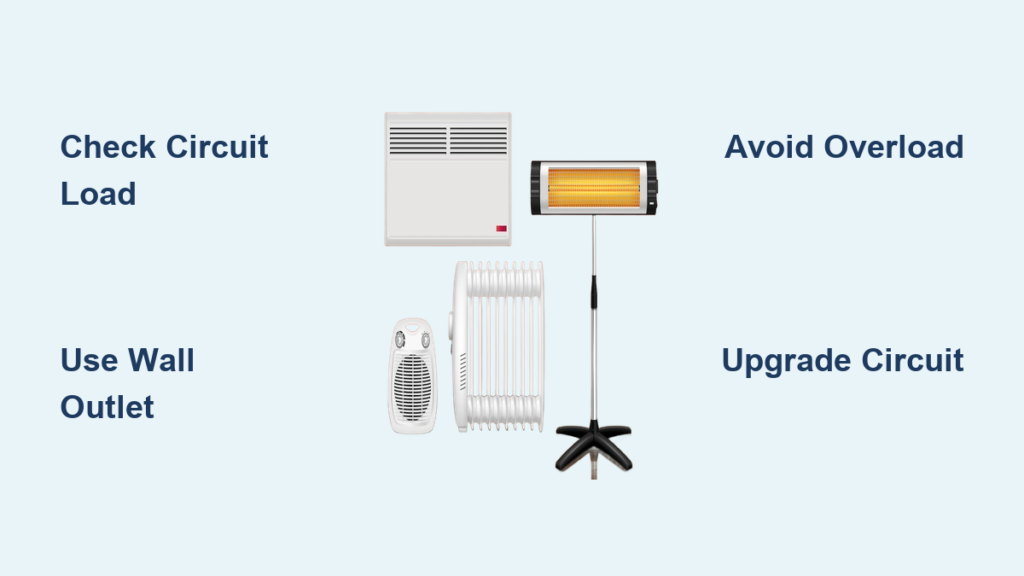
Not every room needs 1,500W. For small spaces, choose ceramic heaters (750W to 1,200W) with thermostats, oil-filled radiators (lower surge current, safer), or infrared heaters (instant heat, zone heating).
These draw less power and cycle on and off, reducing average load. Look for models with eco mode or tip-over protection for added safety.
Alternative: Use an oil-filled radiator in a bedroom overnight. It maintains heat with less cycling and lower peak draw.
Improve Room Insulation to Reduce Runtime
The less time your heater runs, the less strain on the circuit. Boost efficiency with weatherstripping doors and windows, thermal curtains closed at night, door draft stoppers, and sealing electrical outlets on exterior walls with foam gaskets.
In RVs, add insulated window covers or thermal shades to minimize heat loss.
Pro Tip: Reverse your ceiling fan (clockwise) at low speed to push warm air down from the ceiling.
When to Call a Professional
Signs You Need an Electrician
Call a licensed electrician immediately if the breaker trips immediately with no load, outlets are hot to the touch, you see scorch marks, melting, or burning smell, lights flicker or dim when large appliances start, GFCI outlets will not reset, or you are planning circuit upgrades or panel replacement.
These indicate serious hazards like short circuits, failing breakers, or fire risks.
Consider a Panel Upgrade in Older Homes
Homes with 100-amp service may struggle with modern loads. If lights dim when the heater or fridge kicks on, you may need to upgrade to 150A or 200A service. This supports multiple space heaters, electric cooking, heat pumps, and EV chargers.
A licensed electrician can perform a load calculation to determine if an upgrade is needed.
Professional Advice: “Call a pro if your breaker trips immediately after turning on the heater,” says Premier Heating and Air.
Frequently Asked Questions About Space Heater Breaker Tripping
Why does my space heater trip the breaker but nothing else does?
Space heaters draw 1,500 watts, which is the highest wattage of most portable appliances. A 15-amp circuit can only handle 1,440 watts continuously. This leaves almost no room for other devices. Even a small load like a lamp or phone charger can push the total over the limit and cause a trip.
Can I use an extension cord with my space heater?
You should avoid extension cords unless absolutely necessary. Most are not rated for continuous 1,500W use. If you must use one, use only 12-gauge or 14-gauge wire rated for 15A, keep it under 6 feet long, and leave it fully uncoiled. Even then, it is safer to plug directly into the wall.
Is a 20-amp circuit better for a space heater?
Yes. A 20-amp circuit provides up to 1,920 watts of continuous safe load (at 80% capacity). This gives you headroom to run a 1,500W heater plus a few small devices without tripping. You will need 12-gauge wiring, a 20A-rated outlet, and a 20A breaker.
Why does my heater trip the GFCI outlet in my bathroom or kitchen?
GFCI outlets trip when they detect even tiny amounts of current leaking to ground (as little as 5mA). Some older or low-quality heaters emit electrical noise or minor leakage that triggers these trips. The heater may be functioning normally, but the GFCI is overly sensitive. Try using the heater on a non-GFCI circuit.
How do I know if the breaker is old and needs replacing?
Breakers over 15 to 20 years old can weaken and trip below their rated load. If your breaker trips with only the heater plugged in (nothing else), and the heater works fine on other circuits, the breaker may be failing. A licensed electrician can test and replace it.
When should I stop troubleshooting and call an electrician?
Call immediately if outlets are hot to the touch, you see scorch marks or burning smells, the breaker trips immediately with no load, lights flicker when other appliances start, or GFCI outlets will not reset. These are signs of serious electrical hazards.
Key Takeaways for Stopping Space Heater Breaker Trips
A tripped breaker is not a nuisance. It is a lifesaver doing its job. The solution starts with identifying whether the problem is circuit overload, a faulty heater, or underlying electrical faults. Always plug the heater directly into a wall outlet and avoid running other high-wattage devices simultaneously. Use lower heat settings when possible and map your circuits to understand what shares power with your heater.
For permanent fixes, consider installing a dedicated circuit or upgrading to a 20-amp circuit. Replace old or weak breakers and upgrade low-grade outlets, especially in RVs. Choose efficient heater types and improve room insulation to reduce runtime. If you encounter hot outlets, burning smells, or repeated trips with no load, stop using the equipment and call a licensed electrician immediately. With the right approach, you will stay warm and protected.